Digicom Technology News

Showing posts with label Technology. Show all posts

Cloud computing no longer pie in the sky thanks to Vodafone


Digicom are specialists in the areas of audio-visual technology and print/document management, offering an extensive range of leading brand names together with impartial advice. As independent consultants, they work closely with their clients to ensure they get the most e ffective technology option for their needs. Their goal is to deliver a value-added solution which will enhance business processes and optimise productivity and efficiency within client organisations. Established in 1997, they employ 25 people and service the length and breadth of Ireland.

Peter Fox, Director Audio Visual, describes how the company took the decision to move to cloud computing and the impact that had not just on their telecoms requirement, but the way in which the business now operates.

“We decided to make the move to cloud computing, in order to enable us to be more efficient in how we collaborate both internally and externally, and in how we deal with email etc. More than half our employees spend most of their working day out of the office and it was important that they could continue to function in a virtual office while on the road."

"To make it work though, we had to make sure that we had the right voice and data service. We talked to each of the operators and found Vodafone to be the most knowledgeable about cloud computing. They also had the most competitive voice and data tari ff. As a result, we moved our business to Vodafone in August of this year and already we’re seeing the benefi ts."

"Vodafone recommended android handsets based on their experience of cloud computing, and our employees now use them to access and update documents stored on Google Docs and their email via Gmail. The whole country is now their office as they can access everything they need during the course of the day using their phone. The result is a more efficient workforce, particularly our sales people and engineers who spend a lot of time on the road."

"The combined voice and data tariff is also delivering cost savings, although it’s too early to quantify those just yet. Vodafone has enabled us to use cloud computing to take ‘hot desking’ to a new level. We’re con dent that the knock-on benefi ts in terms of our overheads over time will be significant."

"We’re really pleased with the benefi ts so far and are already looking at ways of expanding our use of the technology to further improve productivity and reduce our cost base. Our office based people no longer need to be based in the office so there’s the potential to deploy people to other areas if needs be, and we’re now looking at developing a new cloud based CRM system which will enable the sales team to work from ‘enquiry to invoice’ without ever stepping inside the office."


Bookmark and Share


Samsung's new TV panels are transparent like glass, consume 90% less energy than backlit LCDs.

Samsung recently announced a new range of transparent LCD panels that can be peered through 'like glass'. The 22in transparent LCD panels have been in mass production since March.

According to a Samsung press release, the new screens have a transparency rate of between 15-20% - which makes them transparent enough to look through. The 22in panel boasts a contrast ratio of 500:1 and a native resolution of 1680x1050.

The new panels utilise ambient light when in operation, which allows them to be a lot more energy efficient. If Samsung is to be believed, the new panels consume 90% less electricity than conventional backlit LCD TVs.

The 16in panel will come with HDMI and USB interfaces built-in.

Younghwan Park, a senior vice president of Samsung Electronics LCD Business, said, “Transparent displays will have a wide range of use in all industry areas as an efficient tool for delivering information and communication.”

For the time being, the transparent panels have been earmarked for corporate and educational use as well as in advertising.

Article from PCAuthority.
Read full press release here.


Bookmark and Share

Video conferencing has been around for a long time - roughly since the concept was introduced at the 1964 World's Fair -- and has often been suggested as a way to save travel costs for businesses. The problem is, with many videoconferencing systems and applications that most small business owners have seen, the quality is similar to what you might expect if you were talking to an astronaut on the Space Shuttle. Not quite a substitute for real face-to-face interaction.

The technology has made amazing leaps and has come down in price, so that most small businesses can at least consider deploying video communications for their business -- even in businesses with as few as 10 employees. Suppliers such as Polycom, Siemens, Cisco, Tandberg and others are the big names looking to encourage small businesses (under 1000 employees) to jump into telepresence.

Sue Hayden, executive vice president of video communications supplier Polycom, says the advantage of using what her company called "telepresence" (better technology needs a new vocabulary) goes beyond cutting costs through reduced travel. As important as reducing business travel costs is increasing productivity. People can "interact in a higher quality way and get more done. Visual communications allows companies of any size to meet face to face and ensure they are really productive."

So what's the difference between videoconferencing and telepresence? The latter, says Hayden, is a "high definition video experience that's crystal clear. You can see eyes blinking, people breathing. It's lifelike. It's an immersive experience." Systems today also are more flexible in terms of where they can be used. It can be from an employee's desktop computer, a conference room, or even a mobile computing tablet. Polycom says its systems are "platform independent" - a techie way of saying they go where you go.

A lot of entrepreneurial companies these days are virtual -- their employees may work from home, and they may not even have employees in the traditional sense. They may use talent across the globe with business partners and individuals who work for themselves. Telepresence systems can enable such organizations the flexibility to attract talent from anywhere in the world, knowing that true "like-being-there" communication and collaboration is possible. It's also easier to initiate telepresence contact than with videoconferencing. When individuals are part of a telepresence system, another user can "see" them online and can initiate contact, rather than having to schedule a pre-arranged meeting that employees have to log into.

Polycom has clients like a small magazine publisher with a few dozen employees, many of whom work from home; and a talent casting company with about 20 employees that's on the East Coast and can audition talent from the West Coast without having to fly them in. The technology also lends itself to fields like medical diagnostics, to give healthcare professionals the ability to share patient information remotely; and training/education, enabling organizations to offer higher quality interaction and information sharing.

Hayden says a business owner looking for a video communications system should focus on these questions:

  • Is it easy to use?
  • Is it affordable with a quick ROI?
  • Does it have the quality and reliability that can result in productivity increases?
  • Is it open standards (that is, will it work no matter what other technologies and vendor platforms are already in place)?
  • Is it platform independent, able to work in any environment from a headquarters conference room to a laptop to mobile devices?
Article by , About.com Guide

Bookmark and Share

Digicom invite you to an exclusive free event to showcase the latest advancements in Audio Visual & Office Technology at Dublin's Aviva Stadium on September 29th and 30thDigicom invite you to an exclusive free event to showcase the latest advancements in Audio Visual & Office Technology at Dublin's Aviva Stadium.

WHY JOIN US?
The rise of the internet has enabled the launch of many tools for making and saving money. Smart business is now carried out over IP. Collaboration of technology is saving us time and making our organisations work more effectively. Collaborative technology is rapidly evolving.

Keep up with it’s benefits by visiting this key event in the new Aviva Stadium.

See the latest in:
Collaborative Video/ Voice and Data Conferencing Technology with bridging connectivity
Remote Video Over IP Large Display Messaging

Document Management and Print Output Collaboration

WHITE PAPERS ARE ALSO AVAILABLE ON THE DAY


SESSIONS
WEDNESDAY 29TH SEPTEMBER
9.00am: Document Management – How to work smarter!
Speaker: Rupert Leaton

1.00pm: Immersive Video Conferencing and Telepresence: The last chance saloon for Video Conferencing?
Speaker: Sean Holohan

4.00pm: Video Over IP – places and applications you never thought would be possible!
Speaker: Phil Dodds

THURSDAY 30TH SEPTEMBER
9.00am: Immersive Video Conferencing and Telepresence: The last chance saloon for Video Conferencing?
Speaker: Sean Holohan

1.00pm: Document Management – How to work smarter!
Speaker: Rupert Leaton

4.00pm: Video Over IP – places and applications you never thought would be possible!
Speaker: Phil Dodds

SHOWCASED PRODUCTS WILL INCLUDE:

AUDIO VISUAL EQUIPMENT
Smart Technologies, AMX Itouch, Polycom, Revolabs, Inspired Sinage, Samsung LFD & Extron.

OFFICE TECHNOLOGY

Office Equipment Solutions, Print Management Solutions, eCopy, Ricoh MFP & Printer Hardware, Document Management, Printshop Mail Software Suite & Planet Press.

Visit: WWW.DIGICOMEVENTS.IE to REGISTER

Bookmark and Share

Exterity
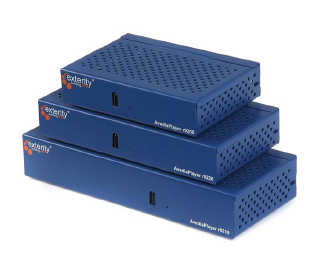
The AvediaPlayer r9200 and AvediaPlayer r9220 feature smaller footprints than previous Exterity HD receivers, with the AvediaPlayer r9200 measuring just 140mm wide by 35mm tall, making it ideal for concealed, behind-screen mounting.

The AvediaPlayer r9220 also features TriplePlay functionality, with a built-in hub providing three additional Ethernet ports that can be used to provide internet access to PCs and VoIP telephone services from a single Ethernet network connection.

Both IPTV receivers have an external USB port that can be used to connect a keyboard and mouse for easier user interaction.

The receivers are compatible with the new Exterity iPhone app that gives users control of channel, volume, language and more using their Apple iPhone or iPad over their organisation’s Wi-Fi Network. Administrators can enjoy fine-grained control over channel display and user access using Exterity’s centralised management applications, as well as standard network access controls and directory services.

Both units include support for a Kensington lock and are compatible with three other optional mounting brackets: an under-desk mount and two behind-screen VESA mounts with a cage that offer additional protection to the units and associated cables for installation in secure accommodation such as hospitals and prisons.


Article from Inavate. More info at Exterity.


Bookmark and Share


EyeClick has introduced the next generation of touch screen technology. With the new EyeTouch, foil is no longer required to enable touch-activated window projection, said the company. The revolutionary optical system takes the place of foil, offering a wider range of options and advantages. Now there are no size limitations for the interactive display, the system integrates with any glass surface regardless of type or treatment, and the installation is simpler and more robust than ever, according to the London, U.K.-based company.


The system has the option to detect and react to passers-by from a distance. EyeTouch has statistic capabilities and the ability to create advanced usage reports for clear ROI analysis. Additionally, there are remote control and monitoring capabilities for high availability and superb reliability. EyeTouch’s user-friendly software can even run on any PC.

For more information visit EyeClick
Bookmark and Share


A new audio/video cable techology is being developed that might spell the end of HDMI cables, which are currently used to connect a wide range of audio and video devices. The new technology is known as HDBaseT and carries audio and video signals and power on standard Cat 5e/6 Ethernet cables.

The new technology has been developed over the last six months by four technology companies: Sony Pictures Entertainment, Samsung, LG, and Valens Semiconductor, which together form the HDBaseT Alliance. The group hopes the new technology and products conforming to it will begin to be shipped later this year and predict its use will become widespread during next year and beyond.

The HDMI (High Definition Multimedia Interface) cable was introduced in 2003 and has been gaining popularity, especially with the rise of Blu-ray and the adoption of high definition television, so much so that almost all televisions now ship with HDMI technology.
HDMI has advantages over other types of audio/video cables but also has disadvantages such as switching delays and cable length limitations, both of which are addressed by HDBaseT. HDMI only carries uncompressed audio and video signals. Wireless technologies such as WiGig, WHDI and Wireless HD offer alternative options, but they cannot transfer power to devices as HDBaseT can.

HDBaseT is a network-based standard called “5PlayTM” that enables a single cable to carry high definition video, audio, up to 100 watts of power, 100BaseT Ethernet, and control signals simultaneously. The cables, which are inexpensive Cat5e/6 type rather than expensive HDMI, can be up to 100 meters in length. The HDMI ports are replaced by standard RJ-45 connectors. The HDBaseT specification supports the latest HD video, 3D, and high resolution 2K x 4K (4096 by 2160).

Article taken from Physorg.com

Bookmark and Share


ClearOne is the leading global provider of audio conferencing solutions. Check out their audio technology for improving conferencing calls.

Bookmark and Share