Digicom Technology News

Exterity
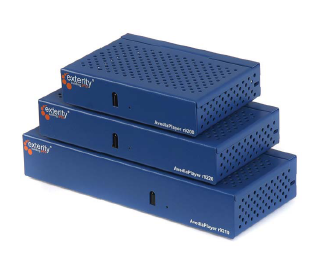
The AvediaPlayer r9200 and AvediaPlayer r9220 feature smaller footprints than previous Exterity HD receivers, with the AvediaPlayer r9200 measuring just 140mm wide by 35mm tall, making it ideal for concealed, behind-screen mounting.

The AvediaPlayer r9220 also features TriplePlay functionality, with a built-in hub providing three additional Ethernet ports that can be used to provide internet access to PCs and VoIP telephone services from a single Ethernet network connection.

Both IPTV receivers have an external USB port that can be used to connect a keyboard and mouse for easier user interaction.

The receivers are compatible with the new Exterity iPhone app that gives users control of channel, volume, language and more using their Apple iPhone or iPad over their organisation’s Wi-Fi Network. Administrators can enjoy fine-grained control over channel display and user access using Exterity’s centralised management applications, as well as standard network access controls and directory services.

Both units include support for a Kensington lock and are compatible with three other optional mounting brackets: an under-desk mount and two behind-screen VESA mounts with a cage that offer additional protection to the units and associated cables for installation in secure accommodation such as hospitals and prisons.


Article from Inavate. More info at Exterity.


Bookmark and Share


EyeClick has introduced the next generation of touch screen technology. With the new EyeTouch, foil is no longer required to enable touch-activated window projection, said the company. The revolutionary optical system takes the place of foil, offering a wider range of options and advantages. Now there are no size limitations for the interactive display, the system integrates with any glass surface regardless of type or treatment, and the installation is simpler and more robust than ever, according to the London, U.K.-based company.


The system has the option to detect and react to passers-by from a distance. EyeTouch has statistic capabilities and the ability to create advanced usage reports for clear ROI analysis. Additionally, there are remote control and monitoring capabilities for high availability and superb reliability. EyeTouch’s user-friendly software can even run on any PC.

For more information visit EyeClick
Bookmark and Share


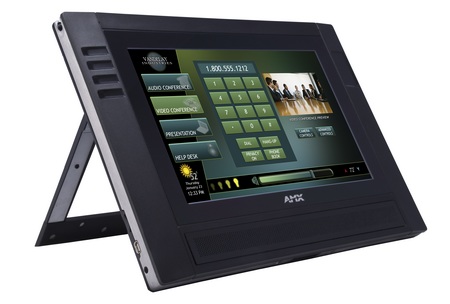
AMX launches the MVP-9000i 9-inch Modero ViewPoint touch panel with ull digital duplex telephone or intercom interface. The panel is ideal for a wide variety of residential and commercial control and automation applications.

The AMX MVP-9000i comes with built-in support for WiFi 802.11a/b/g and is capable of automatically switching between Ethernet connectivity when docked and Wi-Fi when out of dock. It includes new UI capabilities sich as gesturing and page transitions. The MVP-9000i has a 9-inch 800×480 LCD display with LED-backlit, 330-nit brightness, 700:1 contrast ratio; 1GB usable flash memory and a mini SD card slot. There are built-in speaker and microphone.

For more information click here.


Bookmark and Share

Marking yet another category-defining innovation for telepresence, Polycom and McAfee have announced a framework for a global strategic alliance to jointly develop and deliver Secure Unified Communications and Collaboration (UCC). With security threats on the rise, Polycom and McAfee are taking a proactive approach to further enhance the security features of Polycom's video, telepresence and infrastructure solutions.

Polycom plans to design solutions that feature McAfee threat protection, shielding Polycom telepresence users, from the desktop to the fully immersive suite, from potential and increasingly sophisticated security threats while making it easier to comply with privacy and confidentiality mandates.

The alliance will address a growing need for enhanced security as organizations of all sizes increasingly turn to video conferencing and telepresence to reduce costs, improve productivity, and maintain operations in the face of business disruptions. The enhanced protections can also help IT managers in regulated industries from health care to financial services lessen the burden of meeting compliance and reporting requirements.


Full article can be found here.


Bookmark and Share


Last month Vaddio, a leading manufacturer and OEM distributor of specialty pan/tilt/zoom cameras and high-end camera control systems, launched the REVEAL IN-Wall PTZ Camera.

REVEAL IN-Wall cameras are Vaddio’s first architectural integrated PTZ cameras that allow the camera to blend into the wall of any sophisticated videoconferencing or presentation environment. The aesthetics of the camera’s design match large flat screen televisions, rear projection screens and other high-end video equipment. The camera box uses the depth of the wall cavity to recess the camera into the wall eliminating the camera’s extension into the room providing an attractive, finished look to the installation.
For more information visit Vaddio.


Bookmark and Share

Top 10 Teleconferencing Tips

Friday, July 16, 2010 • • 1 comments

Here are some tips to help ensure your teleconferences are as effective as in-person meetings. To read these tips in more detail you can view the original article here.
  1. If you’re using a conference call service, test the service beforehand and make sure that the details are distributed to everyone expected to attend.

  2. Distribute an agenda ahead of the meeting.

  3. Schedule the conference call at a time that suits everyone.

  4. Make sure that the meeting starts on time.

  5. Have people not actively participating in the discussion mute their phones.

  6. Let everyone know that interrupting is OK.

  7. Equipment counts.

  8. Allow time for breaks.

  9. When holding larger meetings, consider either having everyone call in or having everyone present in the office.

  10. Have someone take notes and distribute them after the meeting.
Taken from an article written by Simon Mackie in webworkerdaily.

Bookmark and Share


A new audio/video cable techology is being developed that might spell the end of HDMI cables, which are currently used to connect a wide range of audio and video devices. The new technology is known as HDBaseT and carries audio and video signals and power on standard Cat 5e/6 Ethernet cables.

The new technology has been developed over the last six months by four technology companies: Sony Pictures Entertainment, Samsung, LG, and Valens Semiconductor, which together form the HDBaseT Alliance. The group hopes the new technology and products conforming to it will begin to be shipped later this year and predict its use will become widespread during next year and beyond.

The HDMI (High Definition Multimedia Interface) cable was introduced in 2003 and has been gaining popularity, especially with the rise of Blu-ray and the adoption of high definition television, so much so that almost all televisions now ship with HDMI technology.
HDMI has advantages over other types of audio/video cables but also has disadvantages such as switching delays and cable length limitations, both of which are addressed by HDBaseT. HDMI only carries uncompressed audio and video signals. Wireless technologies such as WiGig, WHDI and Wireless HD offer alternative options, but they cannot transfer power to devices as HDBaseT can.

HDBaseT is a network-based standard called “5PlayTM” that enables a single cable to carry high definition video, audio, up to 100 watts of power, 100BaseT Ethernet, and control signals simultaneously. The cables, which are inexpensive Cat5e/6 type rather than expensive HDMI, can be up to 100 meters in length. The HDMI ports are replaced by standard RJ-45 connectors. The HDBaseT specification supports the latest HD video, 3D, and high resolution 2K x 4K (4096 by 2160).

Article taken from Physorg.com

Bookmark and Share